
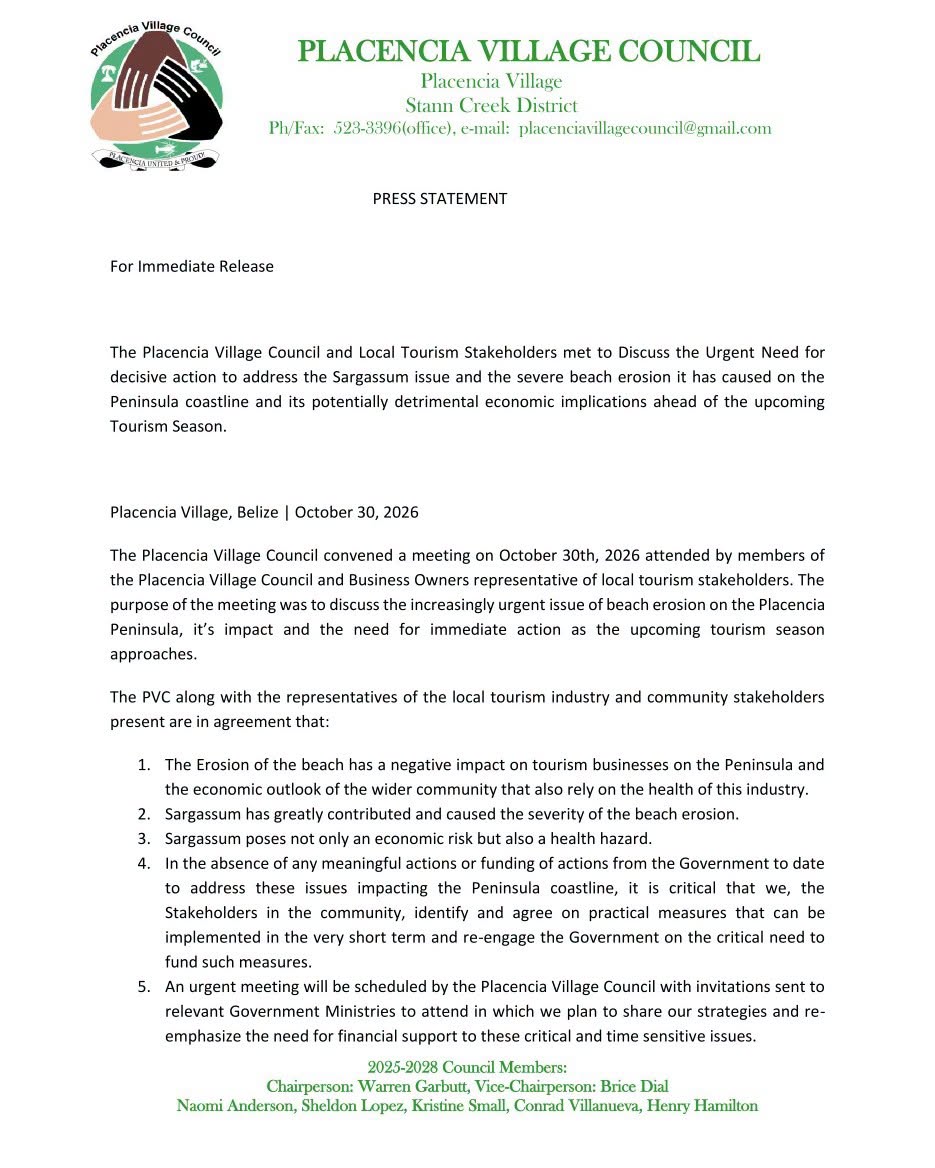
Commentary responding to the October 30, 2026 Council statement. Current funding disbursements, permits and completed restoration works have not been independently confirmed.
Placencia beach erosion: What we know so far
- What the study reported. Preliminary fieldwork linked erosion to structures that interrupt the movement of sand. In April, Chief Environmental Officer Anthony Mai said experts identified man-made shoreline structures as the main driver. The full technical report was unavailable for this review. Fieldwork summary · April reporting
- What is proposed. The Village Council called for urgent sargassum relief and short-term beach restoration. Chair Warren Garbutt described phased beach nourishment, which means bringing sand back onto eroded stretches of beach. Council statement · Love FM’s July report
- Where it stands. Garbutt reported a financing commitment in July. On November 6, Ministry CEO Milagro Matus confirmed receipt of the Council’s letter and said ministries were still seeking resources. October work to protect Placencia Road was reported separately. The public records reviewed here do not confirm disbursement, permits, or a start date for the proposed beach nourishment. Ministry response · Road protection report
Placencia’s beach doesn’t only matter when tourists are coming.
But an approaching tourism season makes the consequences of losing it harder to ignore. Businesses worry about bookings. Workers worry about income. Property owners worry about what the next stretch of rough weather might take.
Those concerns are legitimate. People cannot pay their bills with promises of a long-term solution.
The Placencia Village Council’s October 30 statement reflects that urgency. Following a meeting with local tourism stakeholders, it calls for immediate measures to address sargassum and beach erosion, along with further engagement and financial assistance from Government.
At least, that is the position of the stakeholders who attended. The statement does not identify them or explain whether the meeting was public or invitation-only. We should therefore avoid treating those present as automatically representative of the entire tourism industry or community.
That does not establish that anyone was deliberately excluded. It leaves a reasonable question about participation in decisions affecting a shared coastline.
The larger question, however, concerns implementation.
Placencia has already had scientific investigation, public presentations and proposals for shoreline restoration. How does that work become coordinated action, with funding, responsibilities and progress that people can follow?
Two urgent problems that need a connected response
The Council’s statement says sargassum has greatly contributed to the severity of beach erosion.
That claim deserves examination because our explanation of the problem shapes what we spend money trying to fix.
Sargassum requires urgent management. Decomposing accumulations can release gases, and collection, transport and disposal create practical challenges for communities. People living and working near affected beaches need relief.
But the most visible problem at a particular moment does not necessarily explain a coastline’s longer-term retreat.
In April, Chief Environmental Officer Anthony Mai publicly reported that experts had identified man-made structures along the Placencia coastline as the biggest cause of erosion. That account placed development and shoreline structures firmly within the discussion.
It does not establish that sargassum has no role. Nor should an interview substitute for the full technical findings. It does show why the public needs a clearer explanation of how the different pressures interact.
How much sand reaches the coastline? How does it move? Where is that movement interrupted? What effects do shoreline structures have? How do waves, storms and changing sea levels interact with those conditions?
These questions determine whether an intervention addresses the problem or merely changes its appearance.
Cleanup methods matter too. The United States Environmental Protection Agency warns that heavy machinery used to remove sargassum can carry away substantial quantities of sand, contributing to erosion.
That is a documented risk, not proof that a particular cleanup caused Placencia’s beach loss. It supports a practical principle: sargassum management must protect the remaining sand.
We need urgent sargassum relief and a technically sound shoreline response. Neither makes the other unnecessary.
Recognize the work, then account for the result
The Council describes an absence of meaningful government action or funding.
That frustration should be considered alongside the work already reported.
In December 2025, the Department of the Environment announced support for a shoreline recovery and stabilization study involving the Placencia and Seine Bight Village Councils. Findings and possible responses were publicly discussed in April 2026.
By July, Council Chairman Warren Garbutt was discussing a completed study, proposed phased beach nourishment, approvals and financing. Asked about funding, he told Love FM that financing had been committed, while explaining that processes remained.
Beach nourishment involves placing suitable sand onto an eroded shoreline according to an engineered design.
These steps matter. Scientific investigation and project preparation are necessary work, particularly where an unsuitable intervention could create further damage.
They are also different from completed restoration.
A study identifies conditions and possible responses. A proposal describes intended work. A funding commitment indicates support, but does not by itself establish that money has been disbursed or construction has begun.
October reporting also describes Government placing boulders and hardcore to protect sections of Placencia Road. That intervention has a specific purpose. Its existence does not establish that the village beach-nourishment proposal has been delivered.
Equally, the absence of a verified completion record in the material reviewed here does not prove that no work occurred.
What we need is a current, consolidated account.
Which recommendations are being pursued? Which approvals are in place? What funding is available? What work has started or finished? What remains unresolved, and which institution can resolve it?
Those answers could reveal financing gaps, technical requirements, procurement constraints, administrative delays or several problems together. We should establish the position before assigning the delay to one explanation.
But residents should be able to understand the status of a major coastal initiative without piecing it together from scattered announcements.
The coastline extends beyond property boundaries
Responsibility also extends beyond Government.
When coastal development and shoreline structures are identified as important concerns, property owners, developers and regulators belong in the discussion.
That does not mean every seawall is harmful or every beachfront owner caused the problem. People watching the sea approach their homes or businesses may take emergency measures because they see few alternatives.
Their fear is understandable.
The difficulty is that an individual protection measure must also be assessed for its effects on the wider coastline. Sand movement does not follow property boundaries.
An owner may be trying to protect one parcel. The community needs a functioning beach system. Those interests can overlap, but coordination is necessary.
Public restoration should therefore connect with development decisions, appropriate engineering, consistent oversight and monitoring. Otherwise, we risk investing in recovery while leaving pressures that undermine it unresolved.
The same caution applies to proposed solutions. Rocks, dredging, barriers and other interventions need local technical justification. Looking decisive is not evidence that a measure will perform well.
Urgency makes sound judgment more necessary.
Protect livelihoods and the permanent community
Tourism businesses have an obvious interest in the beach. They support jobs, purchases from suppliers and household income. Protecting those livelihoods serves the wider community.
The discussion must also include people who do not own beachfront property or operate tourism businesses.
Workers, families and residents have a stake in the shoreline, public access and the future character of Placencia. Their interests should be part of the process.
The Council cannot finance or engineer a peninsula-wide response by itself. National agencies, technical specialists, businesses and residents have different responsibilities.
Nor can people facing immediate losses wait indefinitely for every long-term question to be settled.
Practical relief and long-term planning need to proceed together.
A useful public update would identify the work being pursued, its technical basis, available funding, responsible institutions, outstanding requirements and next milestones. It should explain who will maintain the intervention and how its performance will be checked.
That is how a plan becomes something the public can follow.
Beyond the next season
The tourism season gives us a deadline. Protecting Placencia requires a commitment that continues after the season ends.
We should be able to acknowledge work already done while asking what results it has produced. We should be able to support immediate relief while examining the conditions that keep placing the coastline under pressure.
And we should be able to discuss difficult development decisions without turning the issue into a personal fight.
The question is whether each cleanup, emergency intervention and restoration project contributes to a coordinated response that can be sustained.
Our beach is part of our economy, our community life and the place we will leave to our children.
It deserves attention when bookings are strong, when bookings are slow and when no visitor is looking.
Because our beach doesn’t only matter when tourists are coming.
It’s our home.
Sources and reporting limits
- Placencia Village Council statement, October 30, 2026
- DOE shoreline study announcement, December 9, 2025
- Anthony Mai’s account of the findings, April 10, 2026
- Project and financing discussion, July 22, 2026
- Placencia Road protection report, October 21, 2026
- EPA sargassum management guidance
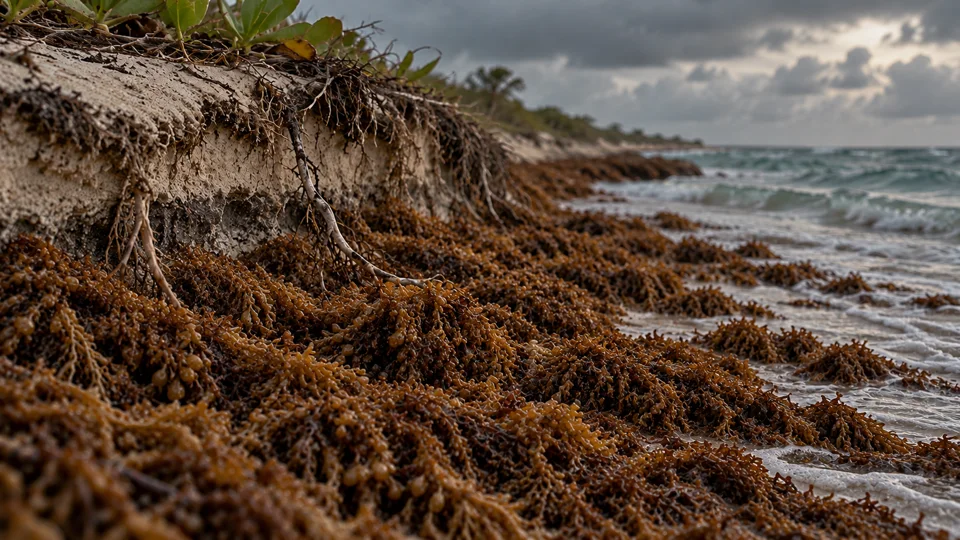
Cover: AI-generated editorial illustration of erosion and sargassum, not a photograph of a specific location. News accounts are attributed reporting, not substitutes for the original technical study.
Thinking out loud.