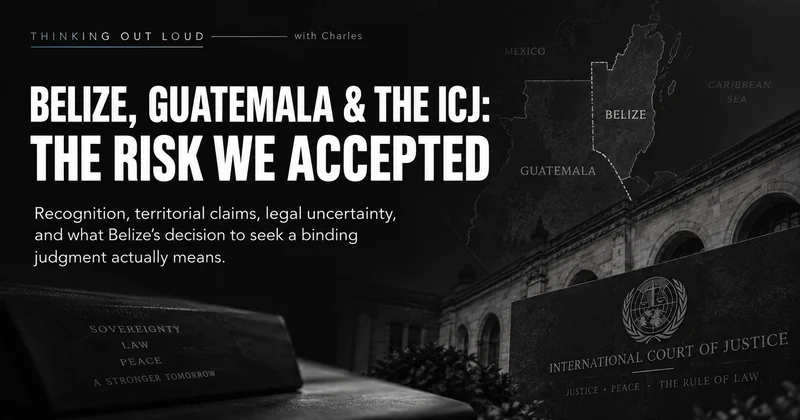
SECTION01The chronology records three important steps: Guatemala acknowledged Belizeans’ right to self-determination on August 14, 1991; recognized Belize’s independence on September 5; and established diplomatic relations on…
Explore section ↗SECTION02Guatemala’s historical position includes an asserted inheritance of Spanish territorial rights and challenges to the extent of British sovereignty. Guatemalan arguments recorded in United States diplomatic…
Explore section ↗SECTION03The Convention signed by Britain and Guatemala on April 30, 1859, is central. Article I describes a boundary beginning at the Sarstoon’s mouth, following the river’s mid-channel to Gracias a Dios Falls, continuing…
Explore section ↗SECTION04On August 25 and 26, 1931, Britain and Guatemala exchanged notes accepting concrete monuments at Garbutt’s Falls and Gracias a Dios Falls. Guatemala’s reply described them as part of the boundary between British…
Explore section ↗SECTION05The November 2001 opinion was prepared by Sir Elihu Lauterpacht, Stephen Schwebel, Shabtai Rosenne and Francisco Orrego Vicuña. It supports Belize’s territorial title, including offshore islands, using treaty-based and…
Explore section ↗SECTION06The dispute is not only a conversation between colonial powers about geography. The rights of the Belizean people form part of the international record.
Explore section ↗SECTION07The 1968 Webster Proposals were an earlier attempt at mediated settlement. The published draft envisaged independence, transit routes, duty-free port arrangements and a joint authority with extensive responsibilities…
Explore section ↗SECTION08The Heads of Agreement signed in London on March 11, 1981, provided a framework for negotiating a fuller settlement. They envisaged recognition of an independent Belize within its existing and traditional frontiers,…
Explore section ↗SECTION09The July 1990 Points of Concurrence at Roatán form another part of the route to recognition. They addressed proposed land-boundary reference points, the Sarstoon’s mid-channel, maritime arrangements and cooperation. The…
Explore section ↗SECTION10The Maritime Areas Act of 1992 generally defined a twelve-nautical-mile territorial sea. But its former section 3 contained a special three-nautical-mile provision for the area from the Sarstoon’s mouth to Ranguana…
Explore section ↗SECTION11The Maritime Areas (Amendment) Act, No. 7 of 2019, gazetted on May 22, removed the negotiation-related provisions. The substituted section 3 sets out a twelve-nautical-mile territorial sea while addressing overlap with…
Explore section ↗SECTION12The OAS-supported process beginning in 2000 combined attempts at settlement with measures to reduce incidents. The facilitators were Sir Shridath Ramphal for Belize and Paul Reichler for Guatemala. Belize’s High…
Explore section ↗SECTION13The first confidence-building agreement in November 2000 established the Adjacency Line and Zone. Further arrangements followed in February 2003 and September 2005. The OAS continues to describe the 2005 framework as…
Explore section ↗SECTION14The OAS office opened in the Adjacency Zone in July 2003. Its contemporary record describes work on cooperation and human rights while the settlement process continued.
Explore section ↗SECTION15The defined Adjacency Line runs north from Gracias a Dios. Its one-kilometre arrangement should not be casually extended to the whole Sarstoon or offshore waters.
Explore section ↗SECTION16The OAS Secretary General recommended ICJ settlement in November 2007. Belize and Guatemala signed the Special Agreement on December 8, 2008. A planned simultaneous referendum in 2013 did not take place.
Explore section ↗SECTION17The scheduled April 10, 2019 referendum was halted by an interim injunction. The Supreme Court’s reasons in Claim No. 151 of 2019 distinguish objections about executive authority and possible constitutional change from…
Explore section ↗SECTION18Article 2 asks the Court to determine Guatemala’s legal claims concerning land, islands and associated maritime areas, declare the rights of both States and determine their respective boundaries. It specifies applicable…
Explore section ↗SECTION19Belize’s government announced that it filed its Rejoinder on June 7, 2023, completing the written-pleading stage described in that announcement. The ICJ case page records the procedural orders and submission…
Explore section ↗SECTION20Sovereignty over an island concerns title to that land. Maritime delimitation concerns the dividing line between relevant maritime entitlements. Resource rights in an EEZ are also not identical to sovereignty over…
Explore section ↗SECTION21Belize instituted proceedings against Honduras in November 2022 concerning sovereignty over the Sapodilla Cayes. On March 19, 2026, the ICJ permitted Guatemala to intervene as a non-party, limited to sovereignty over…
Explore section ↗SECTION22Belize accepted adjudication whose outcome it undertook to implement. That is different from asking for non-binding reassurance. It is also different from conceding Guatemala’s claim in advance.
Explore section ↗SECTION23No. The historical record includes negotiations, mediation, facilitation and confidence-building measures before the Special Agreement. These were different methods of pursuing settlement or managing an unresolved…
Explore section ↗SECTION24Under the Special Agreement, both States commit to accept and implement the judgment in good faith. Article 5 also anticipates a binational commission to demarcate the boundaries. Within three months of judgment, the…
Explore section ↗SECTION25The existing submission is a mutual commitment to adjudication and implementation, not a continuing option to accept only favourable findings. A government’s change of preference is not, by itself, the termination…
Explore section ↗SECTION26A complete public accounting should distinguish legal fees, research and evidence preparation, administration, public education, diplomatic activity and future implementation. It should also distinguish budgeted…
Explore section ↗SECTION27The documentary trail is substantial, but different sources do different jobs. A treaty records agreed wording. A diplomatic note records a government’s position. A legal opinion supplies reasoning. An incident report…
Explore section ↗SECTION28The eventual judgment will tell us what the Court decides. It will not reveal with certainty what would have happened under every alternative path.
Explore section ↗