
Belize Is Not Failing. It Is Frictioning.
- Charles Leslie (JP)

- Feb 22
- 5 min read
Belize is not collapsing.
It is tightening.
And tightening creates friction.
For years, we have interpreted discomfort as decline. We feel resistance in the system and assume the system is breaking. What if what we are feeling is not failure, but transition.
When a country begins to formalize, regulate, digitize, and enforce, it slows down before it stabilizes. That slowdown feels like paralysis. It feels like bureaucracy. It feels like frustration. But friction is not collapse. Friction is contact.
Contact between old habits and new rules. Contact between informal systems and formal institutions. Contact between growth and capacity.
We are living in that contact zone.
The Breakdown
Modernization is not smooth. It never has been.
Belize has formally chosen the direction of digital government. The Digital Government Act (2022) establishes the E-Governance and Digitalization Department and sets objectives such as improving efficiency, strengthening oversight, and streamlining administrative procedures through technology.
Now look at what that direction feels like on the ground.
First, government is treating vehicles like the assets they are. The Government of Belize vehicle policy (2025) explicitly introduces a Government of Belize Vehicle Tracking System, and it tightens rules around authorized use, fuel discipline, and compliance.
That is a shift away from informal use and toward measurable control.
Second, public administration is becoming more documentation-heavy because paper systems cannot survive modern accountability. Through platforms such as mgob.gov.bz, government has begun digitizing services including leave applications, duty leave processing, and Social Security submissions.
That is real movement toward modernization.
But the transition is uneven. The portals exist, yet they are scattered across different websites, departments, and interfaces. There is no single intuitive front door. You often have to actively search to find the correct link, verify which version is current, or determine which ministry owns which service.
Some systems are now online, while others remain manual, fragmented, or partially digitized. The result is a hybrid administrative environment where digital portals coexist with legacy paper processes, and where navigation itself becomes part of the friction.
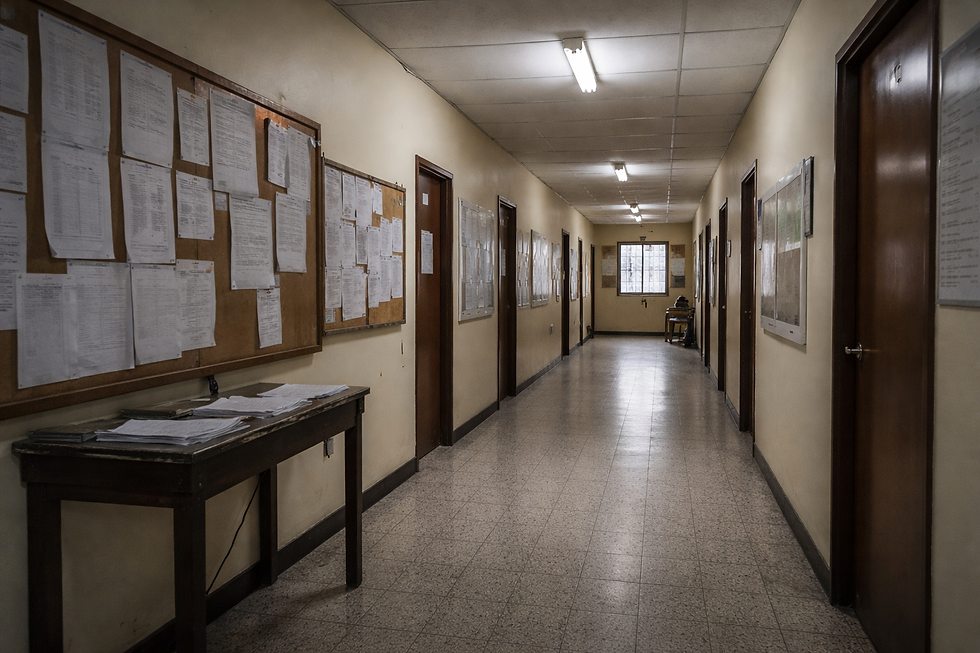
Consider the Ministry of Natural Resources, Petroleum and Mining. Today, if you need to search for land records, verify ownership history, or apply for certain documents, you still physically go to Belmopan. You stand in line. You wait while paper files are manually located. You spend hours navigating a system that remains largely analog.
That experience feels like dysfunction. And in part, it is legacy inefficiency.
But it also reveals the deeper friction: a country publicly committed to digitization is still operating through manual archives. The policy direction is digital. The machine is still paper. The contact between those two realities produces backlog, frustration, and visible strain.
Third, tourism growth has outpaced infrastructure capacity. This is not a theory. It shows up in numbers. Belize welcomed 562,405 overnight visitors in 2024, a 21% increase over 2023, and above pre-pandemic 2019 levels. When arrivals climb faster than roads, waste systems, traffic management, and regulatory staffing, congestion and backlog are predictable outcomes.
None of this automatically equals success. Neither does it equal systemic failure.
When institutions tighten procedures, enforce compliance, or standardize processes, the public experiences inconvenience before it experiences improvement. Licensing becomes slower. Permits become more regulated. Financial oversight becomes heavier. None of this feels like progress in the short term.
It feels like obstruction.
But informal systems, while flexible, are unstable. They rely on personality, shortcuts, and relationships. Formal systems rely on documentation, structure, and accountability. The shift from one to the other produces resistance.
That resistance is friction.
Strain is not failure. It is pressure against limits.
Pressure reveals weaknesses. Weaknesses feel dramatic when exposed.
The More Complex View
None of this means Belize has no problems. It does.
Digital strategy does not guarantee digital execution. A national agenda, an Act of Parliament, and a new department can still collide with limited staffing, legacy processes, weak change management, and uneven enforcement.
In other words, the plan can be modern while the machine remains old.
Crime trends matter. Infrastructure gaps matter. Governance inconsistencies matter. Corruption risks matter. Administrative inefficiencies matter.
If violent crime were rising steadily year over year without institutional response, that would not be friction. That would be structural decay.
If public finances were deteriorating without reform attempts, that would not be transitional strain. That would be mismanagement.
The distinction is critical.
There are two competing narratives.
The first says the country is failing. Systems are collapsing. Nothing works.
The second says institutions are tightening. Expectations are rising. Enforcement is increasing. Growth is colliding with limited capacity. The discomfort is transitional.
The truth likely sits between the two.
Institutional tightening can be clumsy. Reform can be uneven. Enforcement can be inconsistent. Transitional friction can last longer than expected.
And tightening alone is not progress. Rules without capacity harden into rigidity. Digitization without integration creates new confusion. Enforcement without staffing strains compliance.
If tightening is not paired with execution, investment, measurable performance improvement, and institutional strengthening, friction will not stabilize into maturity. It will calcify into decline.
But structural decay has different markers: declining core services, shrinking institutional capacity, abandonment of reform, normalized impunity, sustained fiscal deterioration.
Friction implies adjustment under pressure.
Failure implies erosion without correction.
Those are not the same thing.
The Chain
When a system begins to formalize, three things often happen.
First, speed decreases. Second, complaints increase. Third, visibility of problems expands.
Invisibility was never stability. It was simply unmeasured strain.
As visibility increases, public perception often worsens before outcomes improve.
More reports of crime can reflect improved reporting systems. More administrative backlog can reflect new compliance requirements. More public frustration can reflect higher expectations from citizens who now demand service standards.
However, visibility alone cannot explain everything. Data must be examined carefully. Trends must be tracked over time. Policy intent must be separated from policy outcome.
Expectation growth is not national decay. It is social development.
But development without execution capacity will prolong friction.
And prolonged friction, if unmanaged, can become real decline.
Call to Awareness
We must be disciplined in how we describe our country.
If we label transitional friction as failure, we weaken confidence and distort analysis. If we ignore real weaknesses, we deny accountability.
The task is harder than either extreme.
We must ask:
What is structural? What is transitional? What is mismanagement? What is modernization strain?
Countries do not move from informal to formal systems without noise. They do not modernize without bottlenecks. They do not expand economically without exposing institutional limits.
Belize is not immune to error. But neither is it uniquely doomed.
We are not watching collapse.
We are watching contact.
And contact produces friction.
Clarity requires discipline.
Thinking out loud.


Comments